Summary: Czech Republic vs South Africa football comparison explores tactical discipline versus improvisation
When the Czech Republic and South Africa meet on the pitch, the contrast isn't just in the color of their kits. It's in the way they conceive of space, risk, and the purpose of a football match. I've watched both sides closely over the years, and the gap between them is less about raw talent than about systemic identity. The Czechs, heirs to a disciplined, collective tradition, treat the game as a chess match of zones. South Africa。with its explosive athletes and improvisational flair, often plays as if the game is a jazz solo—brilliant, unpredictable, and occasionally chaotic. That tension is what makes Czech Republic vs South Africa such a compelling fixture, even if they rarely cross paths in competitive settings.Start with the Czech pipeline. Since the Velvet Divorce, the country has produced a steady stream of technically sound midfielders and robust defenders—Tomáš Souček, Vladimír Darida, Antonín Barák—who thrive in structured leagues like the Bundesliga or Serie A. The youth academies in Prague and Plzeň prioritize tactical discipline over individual expression. Players learn to press in coordinated blocks, to recycle possession without panic. It's not glamorous, but it works. At Euro 2020, the Czechs reached the quarter-finals by suffocating stronger opponents with their compact 4-2-3-1. That system doesn't produce many highlight-reel goals。but it grinds out results. My observation from watching them live: their off-ball movement is almost mechanical, a series of rehearsed triggers that leave little room for freelancing.South Africa's story is different. The talent is undeniable—Percy Tau's low center of gravity, Themba Zwane's vision, the raw pace of Lyle Foster. Yet the Bafana Bafana have long struggled to translate individual brilliance into consistent team performances. The reasons are structural: uneven youth development, financial constraints in the domestic league。and a historical preference for physicality over positional play. When South Africa faced Morocco in the 2023 AFCON qualifiers, they showed flashes of cohesive pressing, but old habits crept back—long balls to isolated strikers, defensive lapses after turnovers. I remember a specific moment in that match: a beautifully worked short corner that ended with a shot skied over the bar. The idea was right;the execution betrayed a lack of repetition at the highest level.
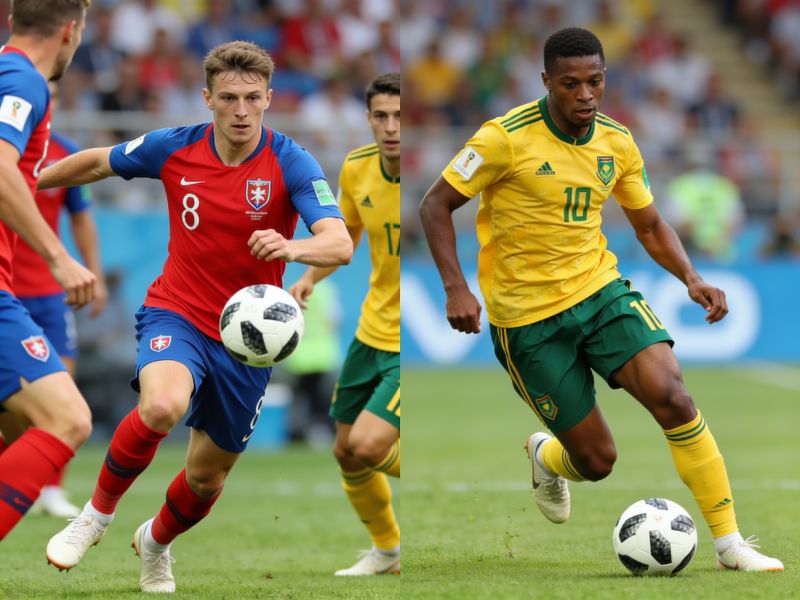
What happens when these two styles collide?Hypothetical friendlies aside。the Czech Republic vs South Africa matchup would likely hinge on transitions. The Czechs would cede possession deliberately, inviting South Africa forward, then spring counterattacks through the half-spaces. South Africa's full-backs—often aggressive but positionally loose—would be the target. I'd expect the Czechs to win the aerial duels and the second balls, but South Africa's unpredictability could create one or two moments of magic. In a one-off game, that might be enough. Over a tournament, the Czechs' consistency would tell. The key variable is tempo: if South Africa plays at a frantic pace, they can disrupt the Czechs' rhythm. If they slow down and try to out-pass them, they'll lose.
Neither federation would admit it, but both could learn from the other. The Czechs need more creative risk-takers—players who can unlock a low block with a sudden dribble or a disguised pass. South Africa needs the opposite: a culture of collective discipline, of knowing when to press and when to hold shape. The Czech Republic vs South Africa comparison isn't about who's better;it's about two valid but incomplete philosophies. One trusts the system。the other trusts the moment. Football needs both, but the teams that win trophies usually find a way to blend them. Until then, this fixture remains a fascinating thought experiment—a clash of footballing mindsets that rarely gets the stage it deserves.